Build pathways together.

Partner with NEXIE

Learning. Enterprise. Meaningful work. Community impact.

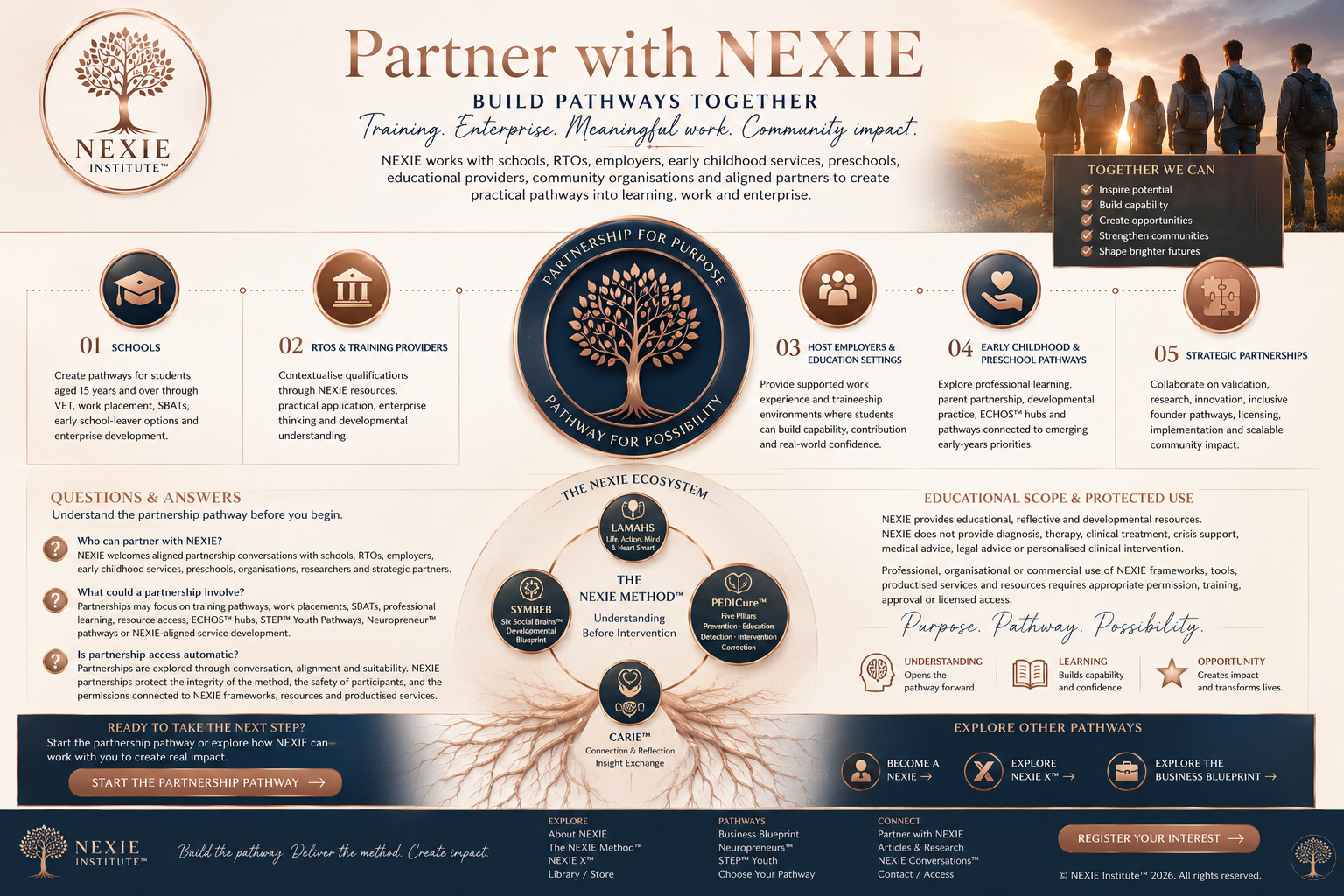
NEXIE is developing partnerships with schools, RTOs, employers, early childhood services, preschools, educational providers, community organisations, researchers and aligned organisations.

Partnership pathways may connect proprietary NEXIE learning and resources with vocational education, professional capability, work experience, employment, enterprise development, research and community-based application.

Each partnership begins with a shared understanding of purpose, responsibilities, participant needs, organisational requirements and the capability needed to deliver the pathway safely and sustainably.

Partner with NEXIE across schools, RTOs, host employers, early childhood and strategic partnerships

Purpose · Pathway · Possibility

01

Schools

Explore pathways for eligible secondary students through vocational education, work experience, school-based apprenticeships or traineeships, enterprise learning and supported transition options.

A school pathway may connect student wellbeing, curriculum participation, career planning, vocational learning and future contribution. Participation remains subject to school approval, learner suitability, family consent where required, RTO arrangements, employer availability and applicable education and training requirements.

02

RTOs and Training Providers

Explore how nationally recognised training may connect with the NEXIE Business Blueprint, proprietary learning resources, enterprise application and relevant field pathways.

The partner RTO retains responsibility for training and assessment, contextualisation decisions, learner entry, competency judgements, work-placement requirements, student records, USI and AVETMISS obligations, regulatory compliance and qualification issuance.

NEXIE Institute does not make competency decisions or issue nationally recognised qualifications.

03

Host Employers and Education Settings

Explore supported work experience, placement or traineeship opportunities through which participants can develop workplace capability, confidence, contribution and practical understanding.

Host arrangements require clearly defined supervision, workplace health and safety, child-safe practice, participant support, insurance, industrial responsibilities and communication between the learner, school, RTO, employer and other relevant parties.

04

Early Childhood and Preschool Pathways

Explore professional learning, parent and family partnership, developmental-environment resources, workforce capability and future pilot pathways connected to the needs of early childhood services and preschools.

Possible pathways may include NEXIE Method learning, educator resources, parent education, ECHOS applications and carefully designed early-support or transition initiatives. Any pilot or implementation pathway would be developed with the setting and governed by appropriate professional, organisational and child-safe requirements.

05

Strategic, Research and Innovation Partnerships

Explore collaboration in research, validation, workforce development, inclusive enterprise pathways, intellectual-property commercialisation, licensing, implementation and scalable community impact.

Strategic partnerships may involve universities, government bodies, industry organisations, researchers, funders, employers, innovation programs and other aligned organisations.

Partnership Development

Begin with alignment
before implementation.

NEXIE partnership pathways are developed according to the purpose, participants, setting, responsibilities and capability of each organisation.

An initial conversation may explore:

  • the need or opportunity being addressed
  • the intended participants and outcomes
  • the role of NEXIE and each partner
  • applicable training, employment or placement requirements
  • participant safety and support
  • resource and intellectual-property access
  • delivery capacity, timing and funding
  • evaluation and evidence requirements
  • whether a pilot, licence, service agreement or other formal arrangement is appropriate

A partnership conversation does not create an automatic agreement or obligation. Any pathway that proceeds will require appropriate due diligence, capacity assessment and documented responsibilities.

Start a Partnership Conversation

Questions and Answers

Understand the partnership pathway
before you begin.

Who can partner with NEXIE?

NEXIE welcomes aligned conversations with schools, RTOs, employers, early childhood services, preschools, educational providers, community organisations, researchers, government bodies, funders and strategic partners.

Potential collaborations may involve vocational pathways, work experience, school-based traineeships, professional learning, NEXIE resource access, STEP Youth Pathways, Future Neuropreneur pathways, early-years initiatives, research, validation or NEXIE-aligned service development.

What could a school partnership involve?

A school partnership may explore vocational education, enterprise learning, career development, work experience, school-based apprenticeships or traineeships and transition pathways for eligible students.

The precise model would depend on student needs, school approval, curriculum and timetable requirements, family involvement where required, RTO availability, host-employer capacity and applicable government requirements.

NEXIE may contribute proprietary pathway resources, Business Blueprint learning, developmental understanding and enterprise-application materials. The school retains responsibility for its students and its educational, wellbeing, consent and governance obligations.

What could an RTO partnership involve?

An RTO partnership may connect nationally recognised training with the NEXIE Business Blueprint, relevant field learning, practical application or enterprise-development resources.

The RTO determines whether and how NEXIE materials can be used to support or contextualise delivery. It remains responsible for compliance, formal learner entry, training and assessment, competency decisions, work-placement requirements, records and qualification issuance.

Nationally recognised training is delivered and assessed by the relevant approved partner RTO.

What could a host employer or early childhood service provide?

A host organisation may provide an appropriate environment for work experience, practical placement, a school-based traineeship, supported employment or an agreed pilot pathway.

Its responsibilities may include suitable duties, supervision, workplace induction, safety, child-safe practice, feedback and communication with the learner and relevant partners.

The precise responsibilities depend on whether the arrangement is work experience, vocational placement, paid employment or a formal apprenticeship or traineeship.

Can NEXIE support preschool or early-years settings?

NEXIE can explore pathways involving professional learning, parent partnership, developmental understanding, educator resources, environmental reflection, transition support and future NEXIE program applications.

The scope would be developed with the service or preschool. NEXIE resources do not replace approved learning frameworks, regulatory requirements, child-protection obligations, professional judgement or specialist services.

Is partnership access automatic?

No. An enquiry begins an exploratory conversation.

Before any partnership proceeds, NEXIE and the prospective partner must determine whether there is sufficient alignment, capability, capacity and an appropriate delivery model.

Formal pathways may require due diligence, a written agreement, defined responsibilities, funding, insurance, intellectual-property conditions, participant safeguards and any relevant school, RTO, employer or regulatory approvals.

Purpose. Pathway. Possibility.

Build pathways together.

Shared purpose → defined participants → clear responsibilities → appropriate capability → formal agreement → pilot or implementation → evaluation and growth.