
NEXIE IN — Philosophy into Everyday Practice
Bring Your Philosophy into Everyday Practice.
What will your commitments look like in educator actions, children’s experiences and partnerships with families?
A focused 12-week partnership for early childhood and family day care services. Turn one selected philosophy commitment into an achievable practice inquiry, prepare an internal facilitator and review what the approach adds in your setting.
Prefer self-guided learning? Browse available NEXIE IN resources →
Shared purpose. Prepared people. Visible improvement.
View illustrated guide: A focused implementation partnership
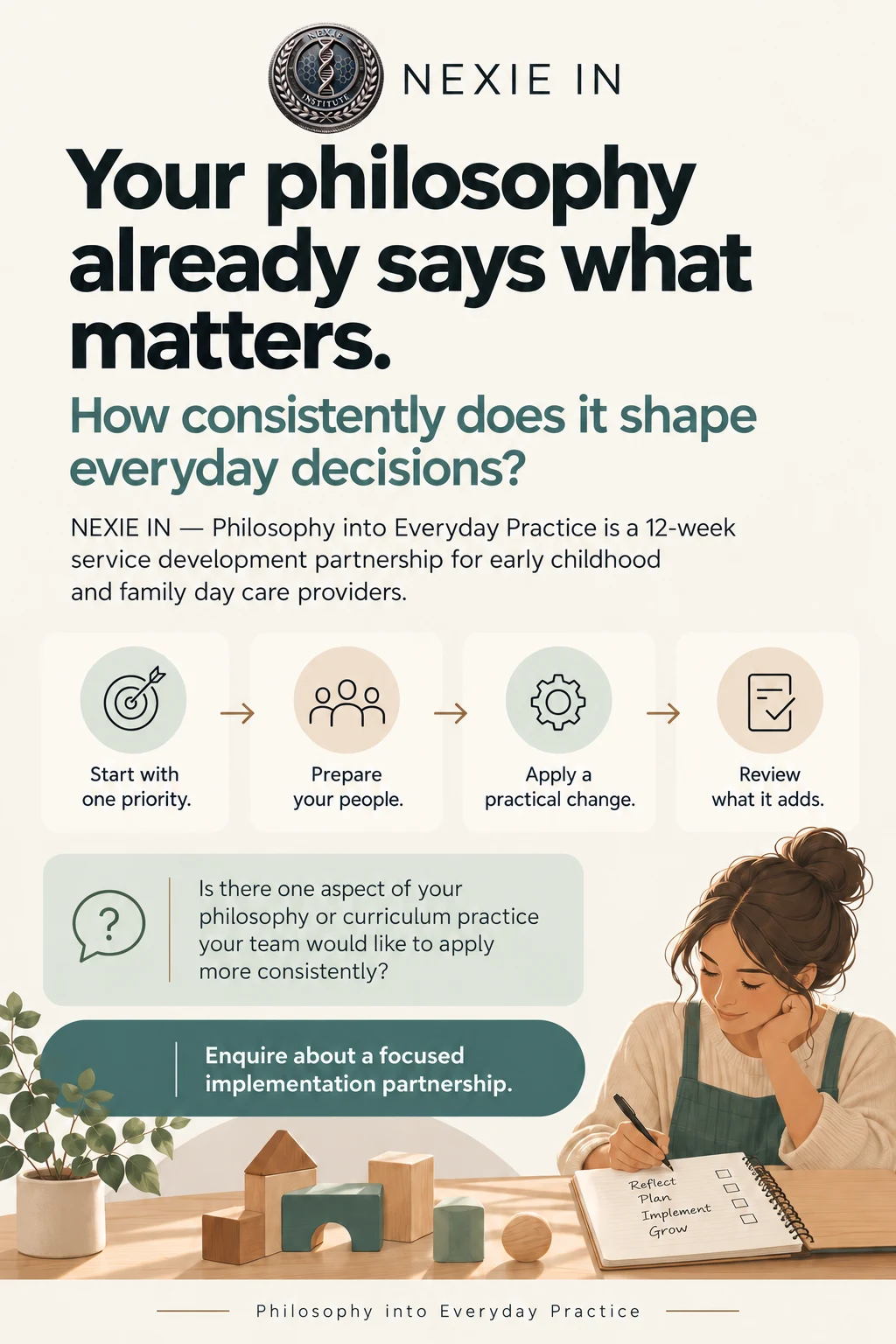
Start with what matters locally
Choose one useful change.
A philosophy becomes useful when people can recognise it in everyday decisions. Choose an inquiry that fits your children, families, workforce and current priorities.
Strengthen family contribution to planning
Improve participation in one routine or environment
Build shared language for adult decisions
Make documentation useful for reflection
Prepare a facilitator to carry the work forward
The core partnership
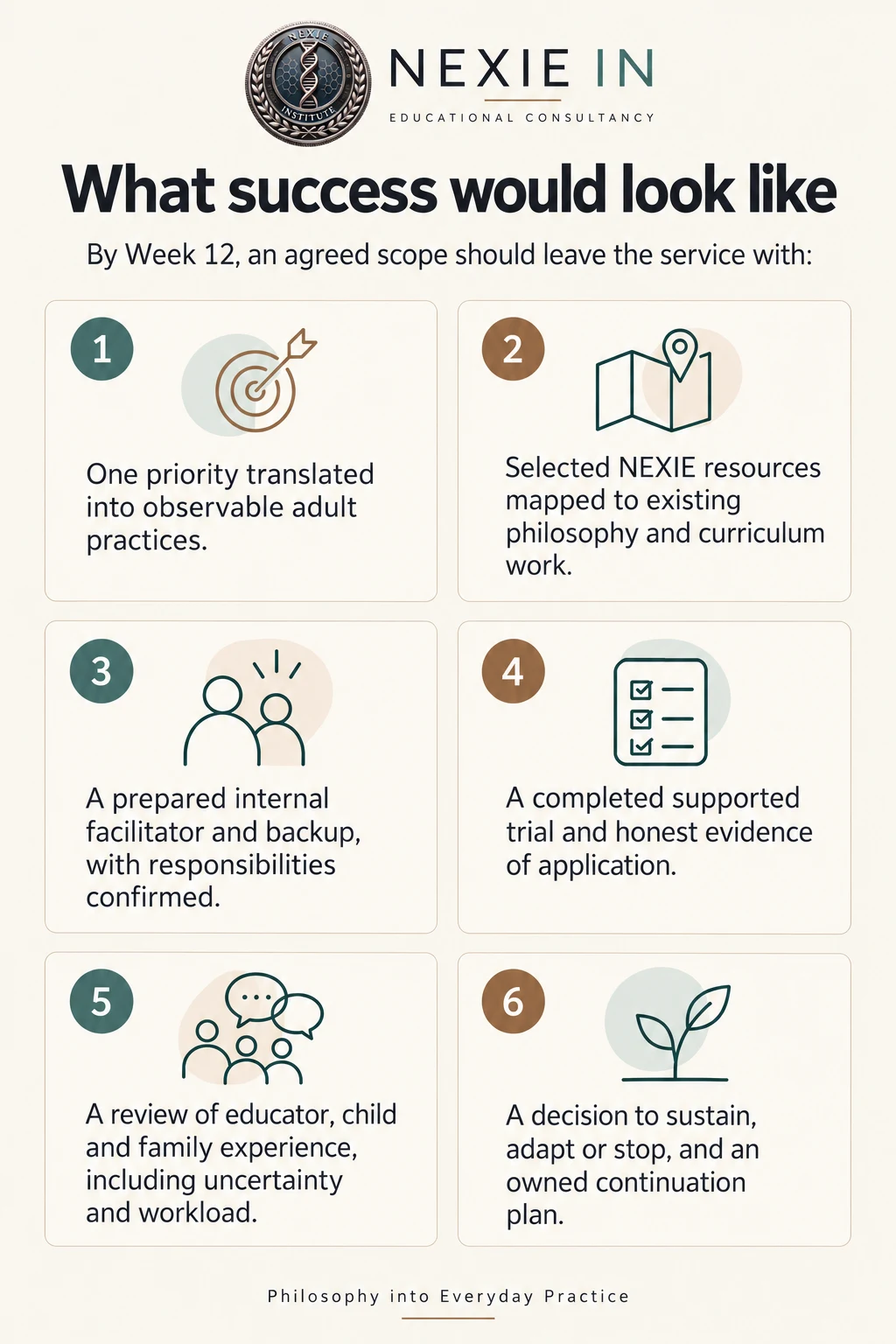
Six practical handover outcomes.
One provider, one agreed inquiry and a cohort of up to six educators, including the facilitator and backup. Two 45-minute remote conversations or an agreed asynchronous equivalent, plus three consolidated feedback rounds across 12 weeks.
Joint Service Development Plan
One agreed practice inquiry, starting evidence, service roles, participation and review measures.
Philosophy-to-practice map
Connect a selected commitment with adult actions, curriculum or routines, family contribution, responsibility and evidence.
Internal facilitator preparation
Prepare one facilitator and orient one backup to guide the agreed inquiry and use the selected resources.
One supported practice trial
A bounded change in one routine or learning context, with an implementation record and proportionate adjustments.
Contribution review
Compare starting evidence with actual practice, participation, family input and workload; agree what to continue, adapt or stop.
Continuation and handover
A service-owned evidence index, final resource set, responsibilities and a practical 90-day continuation plan.
Selected implementation resources are adapted within the agreed scope. The service supplies protected staff time, family consultation, staffing, local approvals, trial delivery and authorised records. NEXIE tailors, prepares, supports and reviews within the agreed scope.
View illustrated guide: What success would look like by Week 12
Request a scoped proposal. Confirm the inquiry, team-use permissions, contact arrangements and investment together before starting.
What NEXIE brings
Developmental understanding, applied locally.
Use NEXIE alongside the EYLF or other applicable approved framework, your philosophy, family knowledge and professional judgement.
Neuroeducated philosophy
Connect relationships, environment, developmental knowledge and individual experience with the service’s own commitments.
LAMAHS
Use Life, Action, Mind and Heart Smart as planning lenses, with opportunities for caring, connection, creativity, critical thinking, creative problem solving and contribution.
SYMBEB
Explore strengths, preferences, communication and helpful conditions; check observations against the person’s experience.
PIEA1
Use supplied learning, worked examples, practical application and reflection. Optional AI prompts support adult thinking and verification.
GEMS
Universal family learning through shared play, brief conversations and optional ideas for home.
ECHOS
Family-agreed, targeted educational participation adjustments within facilitator competence, with review of what helps.
NEXIE IN
Connect local setup, prepared people, supported implementation and continuity in an existing service system.
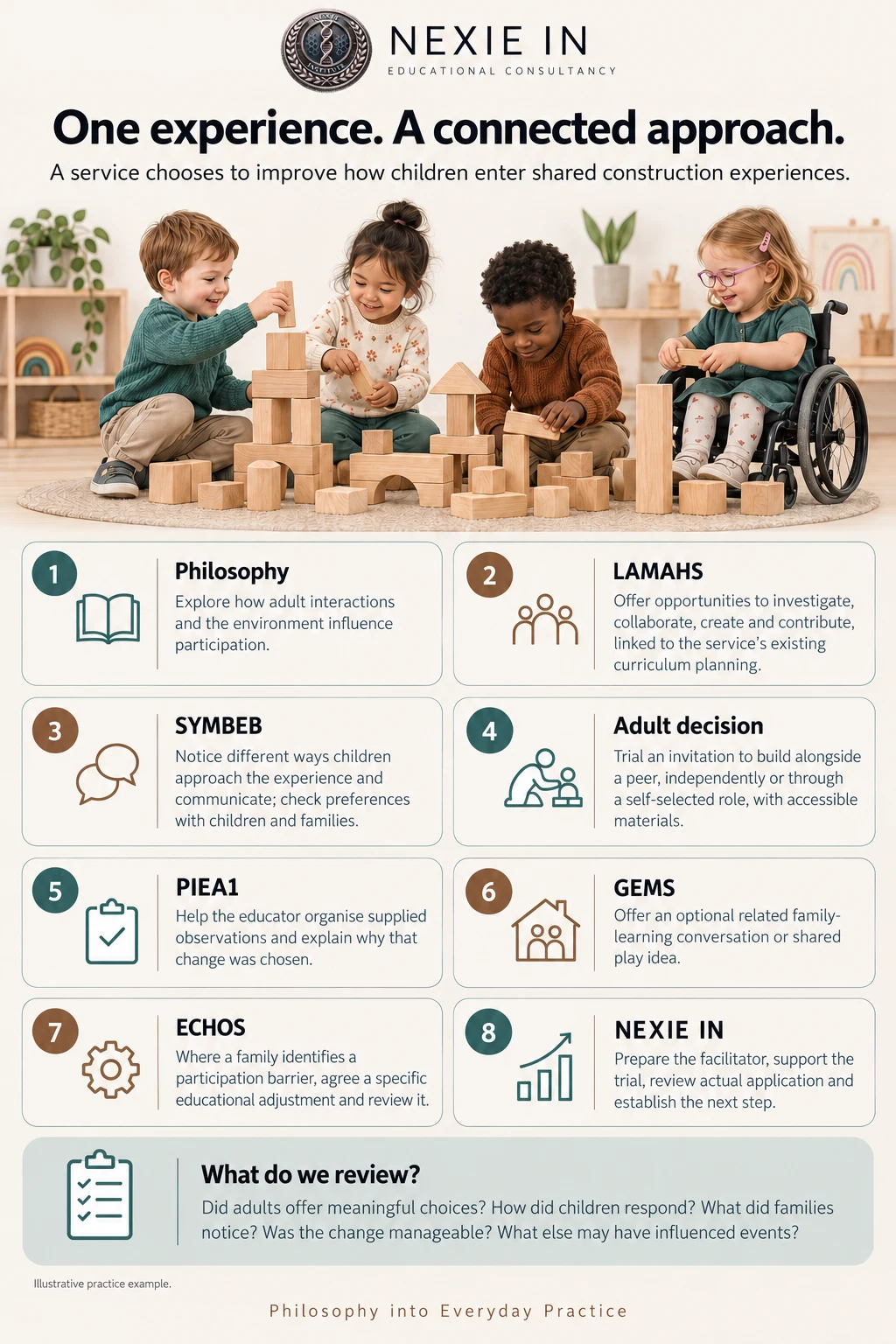
See an illustrative practice inquiry
A service values children’s agency and chooses construction play as its inquiry. The team records current invitations, seeks family and child perspectives, considers different ways to join, and agrees one adult-practice change. LAMAHS supports planning; SYMBEB prompts attention to preferences; PIEA1 supports reflection. The team records what actually happens and decides what to retain. Review actual choice-offering, children’s responses, family perspectives, feasibility and alternative explanations. This is a fictional example, not a client result.
GEMS or ECHOS may provide a relevant separately scoped family-program connection. NEXIE IN supports the local implementation process.
View illustrated guide: Illustrative construction-play inquiry
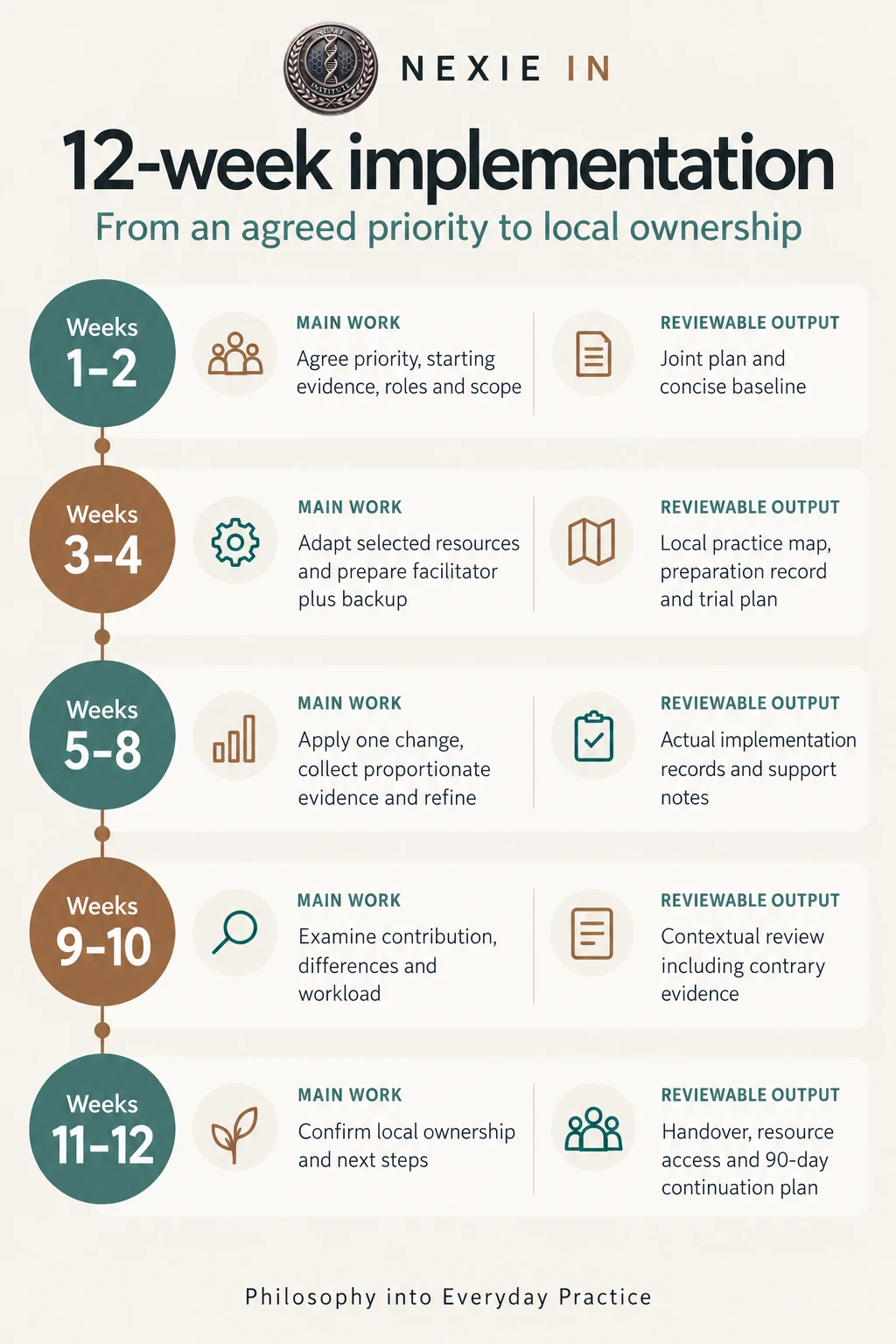
The 12-week pathway
Agree. Prepare. Apply. Review. Continue.
01
Weeks 1–2
Agree the purpose
Choose one commitment and inquiry. Record the baseline, success indicators, responsibilities and family consultation approach.
You leave with: Joint plan + starting evidence
02
Weeks 3–4
Prepare people and practice
Adapt selected resources, build the philosophy-to-practice map and prepare the facilitator and backup.
You leave with: Practice map + preparation record + trial plan
03
Weeks 5–8
Apply and refine
The service leads one practice trial. Consolidated feedback helps the facilitator document what changed and adjust the approach.
You leave with: Implementation record + support notes
04
Weeks 9–10
Review the contribution
Compare actual application with the starting point. Include family perspectives, alternative explanations and educator workload.
You leave with: Contribution review + continuation decision
05
Weeks 11–12
Carry it forward
Consolidate the evidence, hand over the local resource set and identify who will lead the next review.
You leave with: Evidence index + 90-day plan
View illustrated guide: The 12-week implementation timeline
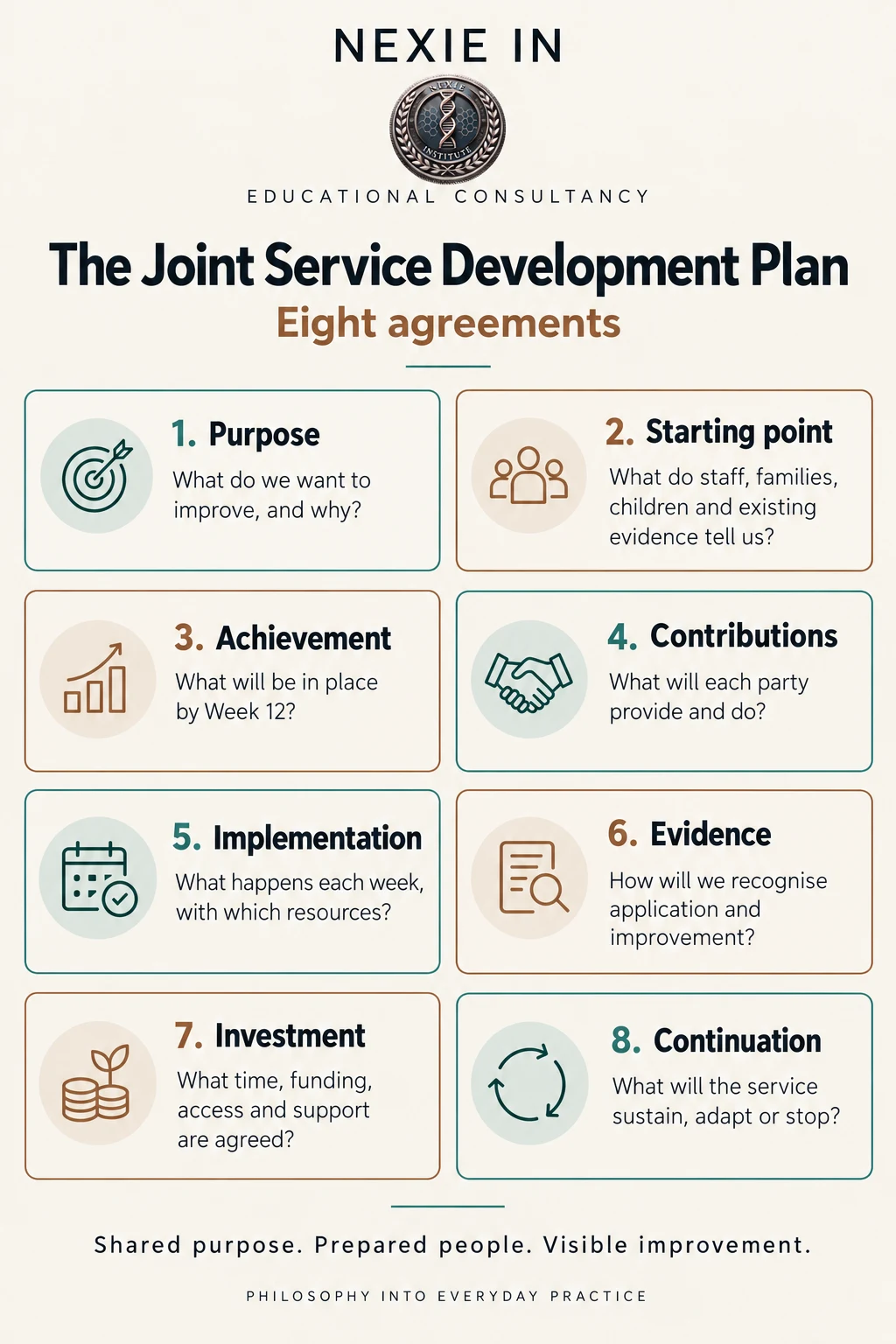
Eight agreements guide the work
Purpose
What do we want to improve, and why?
Starting point
What do staff, families, children and existing evidence tell us?
Achievement
What will be in place by Week 12?
Contributions
What will each party provide and do?
Implementation
What happens each week, with which resources?
Evidence
How will we recognise application and improvement?
Investment
What time, funding, access and support are agreed?
Continuation
What will the service sustain, adapt or stop?
View illustrated guide: Eight agreements for a locally owned partnership
Progress is reviewed through completed outputs and actual application. Each service retains ownership of its decisions and evidence.
Add only what your service needs
Choose your service pathway.
Strengthen everyday service practice: begin with the focused core inquiry. Build a developmental playgroup and parent-learning service: agree a separate setup pathway covering preparation, resource permissions, pilot delivery and review, staffing, venue, insurance and ongoing operation.
Separately scoped options
Philosophy and family consultation
Develop a full service statement of philosophy, wider consultation process and a broader philosophy-to-practice map.
Discuss this option →Role-based induction and learning space
Design role pathways, completion records and local examples. Configure an intranet or SharePoint space after verifying tenancy, permissions and ownership.
Discuss this option →Curriculum and shared response resources
Develop additional annotated curriculum examples, intentional-teaching decisions, routine adjustments or a whole-service wellbeing and behaviour response guide.
Discuss this option →Family programs and playgroups
Scope NEUROPREP transition work, CARIE family connection, GEMS or ECHOS separately, including workforce preparation, delivery rights and local operating arrangements.
Discuss this option →Individual assessment and specialist planning
Agree assessment, report and Step 4 planning requirements through the relevant professional pathway and pricing.
Discuss this option →Qualification and enterprise connections
Explore RTO-reviewed learning alignment or the Business Blueprint and Neuropreneur pathway as a separate engagement.
Discuss this option →Each option has its own outputs, hours, investment and responsibilities. Program delivery and team-wide resource permissions are agreed for the selected setting.
A resource route of your own
Practice Implementation & Evidence Playbooks
First Edition · Learn the concept → See a fictional worked example → Build your response → Review and verify.
Complete collection
NEXIE IN — Practice Implementation & Evidence Playbooks
AUD $149
8 PDFs · 31 pages
IMP00 Start Here; IMP01 Purpose; IMP02 Starting Evidence; IMP03 Interpretation; IMP04 Decision; IMP05 Application; IMP06 Review; IMP07 Working Records.
IMP01
NEXIE IN IMP01 — Purpose
AUD $9
3 PDFs · 11 pages
Define one inquiry connected to your service philosophy. Includes Purpose, Start Here and Working Records.
IMP04
NEXIE IN IMP04 — Decision
AUD $9
3 PDFs · 11 pages
Turn your starting evidence into an agreed adult-practice change. Includes Decision, Start Here and Working Records.
IMP06
NEXIE IN IMP06 — Review
AUD $9
3 PDFs · 11 pages
Use your baseline and implementation notes to agree what continues. Includes Review, Start Here and Working Records.
Choose once. Avoid duplicate purchases.
The collection contains all six applications plus the start guide and working records. Each single contains one application and the same seven shared pages. All three singles cost $27 and contain 19 unique pages; the collection costs $149 and contains 31 unique pages. The collection adds Starting Evidence, Interpretation and Application; it is not presented as a discount bundle.
Individual resources are licensed to one named adult, with participant working-page copies permitted. Cohort use for consultancy needs written team permissions. Check any existing purchase or proposal before buying.
Useful answers
Choose the right next step.
How does this connect with EYLF and quality improvement?
Your inquiry connects the service philosophy, planning, family knowledge and critical reflection. The resulting records can inform service self-assessment and QIP discussions. Your service verifies any formal mapping for its context.
Is this suitable for a new service?
Yes. Begin with a selected commitment while establishing practice, or strengthen an existing approach. Full philosophy development can be separately scoped.
What is the difference between resources and consultancy?
The PDFs support an adult-led inquiry. Consultancy adds agreed local adaptation, facilitator preparation, bounded feedback, review and handover. Full PIEA1 learning, specialist reports and program delivery are separate offers.
Can we use our own learning or record system?
Yes. Use the agreed records within an appropriate service-owned system. Intranet construction and substantial configuration are separately scoped after access is verified.
Do we need AI?
AI prompts are optional. Adults verify content, protect information and retain decisions. No AI account is supplied.
Is the partnership educational or clinical?
This is developmental education and supported practice inquiry. Individual clinical assessment, diagnosis and therapy are provided through the appropriate professional services.
Can we add a playgroup or family-learning program?
Yes, through a separate implementation scope covering program choice, staff preparation, permissions, venue and delivery arrangements.
What outcomes are reviewed?
Completion of the agreed outputs, actual changes to adult practice, participation, family contribution and workload. Consultancy supports educational practice; assessment-and-rating decisions remain with the relevant authority.
Need tailored support?
Explore a Scoped NEXIE IN Consultancy Partnership.
Tell us your service type, priority, approximate cohort size and whether you prefer written contact or a remote conversation. Keep the enquiry about service practice.
Explore a 12-week partnership →No sensitive child or family information is needed in the enquiry.